
H1 2026 roadmap: strengthening IoT/OT security through practice
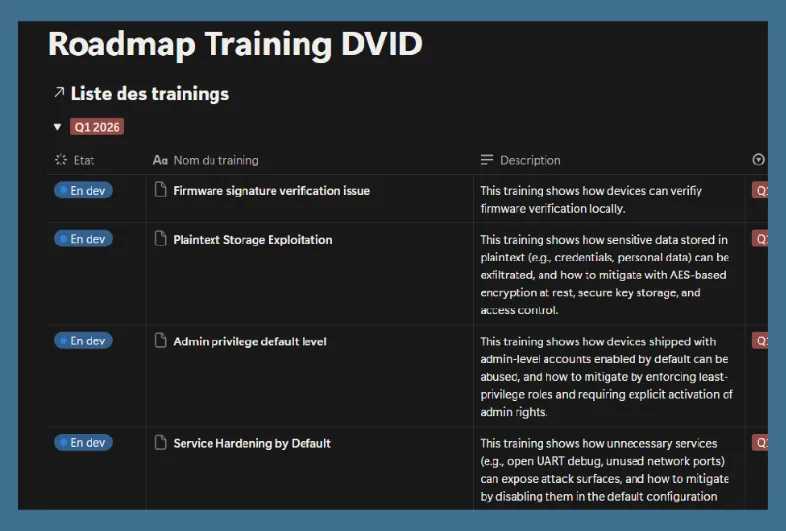
The first half of 2026 marks a new step in our mission: making IoT/OT security accessible, operational and directly applicable in the field. This H1 2026 roadmap is built around two clear axes: Q1 dedicated to offensive and defensive fundamentals, and Q2 focused on maturity, resilience and compliance.
Each module stays true to our approach: concrete, reproducible scenarios based on real vulnerabilities, so that technical teams, manufacturers and integrators can quickly build their skills.
Q1 2026 — Building the foundations: understand, exploit, fix
The first quarter is dedicated to the vulnerabilities most frequently observed in IoT/OT environments, whether they affect the cloud, the firmware or hardware interfaces. The goal: master the basics, identify critical flaws and understand how they are exploited in the real world.
Cloud
- Vulnerable MQTT Server — Understand the pitfalls of a misconfigured broker and the risks of interception or spoofing.
- Misconfiguration on OTP distribution — Analysis of common mistakes in one-time password mechanisms.
Hardware & Firmware
- Firmware signature verification issue — Demonstrating the risks of an incomplete chain of trust.
- Plaintext Storage Exploitation — Extracting and exploiting secrets stored without encryption.
- Admin privilege default level — Impact of administrator privileges enabled by default.
- Service Hardening by Default — Why the lack of initial hardening paves the way for quick compromises.
- Unsecure Debug – UART — Unauthorized access through exposed debug interfaces.
- Unsecure BLE pairing — Attacks on weak or unauthenticated pairing mechanisms.
- Unencrypted firmware — Direct analysis and modification of an unprotected firmware.
- OSINT the board to compromise the device — Using public information to speed up hardware compromise.
- Default password on firmware — Detecting and exploiting hardcoded passwords.
- Firmware dumping — Full firmware extraction through physical interfaces.
- Remote injection from BLE characteristics — Injecting malicious data through vulnerable BLE characteristics.
- Information leakage on BLE serial — Information leaks through unfiltered BLE channels.
Q2 2026 — Growing in maturity: resilience, compliance and advanced security
The second quarter introduces more advanced scenarios, focused on resilience, update security, dependency management, anomaly detection and the integration of disclosure best practices.
Cloud
- Secure Update Channel Implementation — Setting up an end-to-end secure update channel.
- Data Transfer Confidentiality issue — Analysis of the risks of unencrypted transfers.
- Open Port Scanning and Exploitation — Identifying and exploiting exposed services.
- Misconfiguration on monitoring – Cloud — Detecting configuration errors in monitoring systems.
Hardware & Firmware
- Enforcing Least Privilege on UART — Strict application of the least privilege principle on debug interfaces.
- Access Control Enforcement on UART — Robust access controls on hardware interfaces.
- Fuzzing of External Interfaces — Targeted fuzzing to reveal unexpected behavior.
- Vulnerability Identification with SBOM — Using an SBOM to identify vulnerable components.
- Dependency Mapping and Transparency — Mapping software and hardware dependencies.
- Residual Data on Factory Reset — Analysis of data that persists after a reset.
- Log Integrity Protection issue — Detecting log tampering.
- Debug Interface Logging (UART/JTAG) — Secure logging of debug access.
- Firmware Attack Surface Reduction — Reducing the firmware attack surface.
- I2C Bus Lockup Propagation — Understanding I2C lockups and how they propagate.
- BLE Connection Flooding — BLE connection saturation attacks.
- Silent Data Corruption Detection — Detecting silent data corruption.
- Data Corruption in Transit — Analysis of data corruption in transit.
- Side-Channel Data Leakage – Glitch — Introduction to glitch attacks and side-channel leaks.
- Misconfiguration on monitoring – Device — Configuration errors in embedded monitoring.
- Misconfiguration on Partial Update Failure — Risks of poorly handled partial updates.
Middleware
- Data Modification Tracking — Tracking data changes in intermediate layers.
- Unnecessary Sensor Data Capture — Reducing collected data to limit exposure.
- Weak Encryption Algorithm Attack — Attacks on obsolete encryption algorithms.
Policy & Governance
- Vulnerability Disclosure and Triage — Setting up a responsible disclosure process.
- Insecure Data Deletion — Risks of insecure data deletion.
An operations-driven roadmap
This H1 2026 roadmap reflects our commitment to offering concrete, reproducible and directly usable modules for technical teams, manufacturers, integrators and auditors.
It covers the entire life cycle of an IoT/OT product: cloud, firmware, hardware, middleware, governance.
Our goal remains unchanged: raising the security level of the IoT/OT ecosystem by combining pedagogy, realism and operational efficiency.
You can follow our roadmap in real time here: https://www.notion.so/Roadmap-Training-DVID-325e7623a0128058972ecd9dda6d5710
Learn more: https://dvid.eu
Contact us: https://dvid.eu/#contact
Follow our news: https://www.linkedin.com/company/dvid