
Default administrator privileges: when a "guest" account controls the whole device
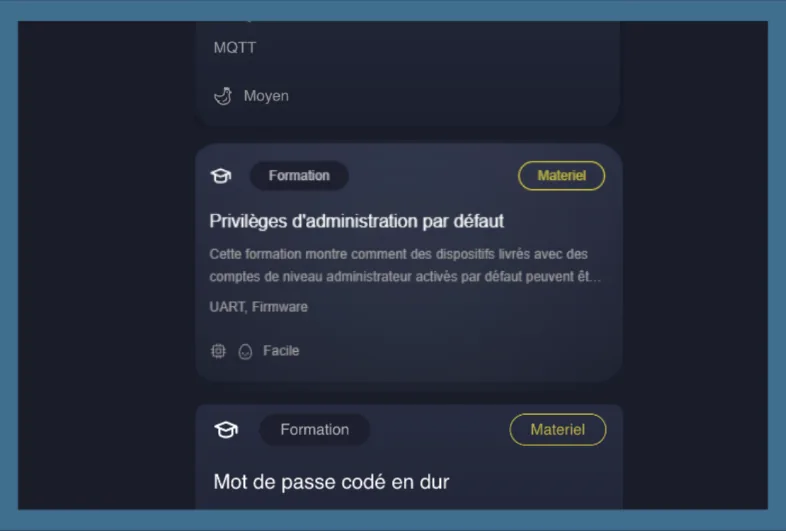
A new DVID training to explore the dangers of misconfigured roles on embedded systems
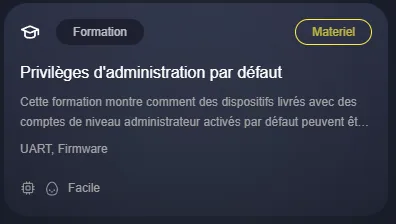
A guest account shipped with administrator rights. It sounds like a glaring mistake, and yet it is one of the most common flaws on IoT/OT devices in production. Industrial sensors, connected probes, field gateways: many devices are deployed with default accounts whose privileges have never been reviewed.
This new DVID training lets you experience this flaw from the inside: understanding how an attacker, with simple physical access and a "guest" account, can take full control of an embedded system — without exploiting a single software vulnerability.
A 100% hands-on approach, true to DVID's DNA
In line with our teaching approach — making IoT cybersecurity concrete, accessible and lasting — this module puts participants in front of a real microcontroller simulating an industrial temperature probe, with a multi-user authentication system.
As with our other trainings, the goal is clear: learn by doing, not by theorizing.
Participants learn how to:
- connect to a device over UART with documented credentials,
- explore the available commands to map an account's privileges,
- identify poor role separation on an embedded system,
- escalate privileges up to fully impersonating an administrator account,
- check whether the least privilege principle is correctly applied.
This approach matches the spirit of our open source platforms: giving people the means to understand, reproduce and fix.
A real-world scenario: when least privilege does not exist
The training relies on an intentionally vulnerable firmware, representative of what is found in the industry. The scenario simulates a connected temperature probe, accessible over UART, with several preconfigured user accounts.
Without revealing the technical details, participants quickly realize that:
- an account supposed to be limited actually has full administrator rights;
- this misconfiguration allows changing other accounts' access without any control;
- the system's logging does not identify the real author of fraudulent actions;
- physical access to the UART interface bypasses all application-level protections.
This type of flaw is directly covered by the Cyber Resilience Act (CRA) — Annex I, and relates to three requirements: default credential management (2b), access control and privilege separation (2d), and attack surface minimization (2k). This training covers all three compliance points.
An embedded experimentation lab
Just like the open source DVID board, this training turns a simple exercise into a real lab for analyzing embedded access management.
Participants work with:
- an ESP32 or an STM32,
- a UART interface at 9600 baud,
- a multi-account authentication system (guest, admin, operator),
- user and password management commands.
Each step is progressive — from discovering the device's behavior to taking over accounts — and directly applicable in an audit or secure design context.
Key takeaways for participants
Beyond the exercise, the training builds essential reflexes for designing and auditing embedded systems:
- never ship a device with accounts holding more privileges than their role requires;
- strictly apply the least privilege principle to every account;
- strengthen controls on critical operations (password changes, account management);
- implement reliable, timestamped and tamper-proof logging;
- secure or disable the UART interface in production depending on the system's criticality.
These best practices are at the heart of CRA compliance and modern IoT/OT security.
Who is it for?
This module is designed for teams that design, audit or operate embedded systems:
- firmware engineers,
- IoT/OT architects,
- pentesters,
- security managers,
- product teams who want to build security in from the design stage.
No advanced prerequisites are needed: everything is explained, demonstrated and put into practice. The scenario is designed to be accessible from the very first minutes.
Available now
This training fits naturally into an IoT/OT upskilling path, whether to strengthen an internal team, prepare for CRA compliance or structure a security-by-design approach.
Learn more: https://dvid.eu
Contact us: https://dvid.eu/#contact
Follow our news: https://www.linkedin.com/company/dvid/